

Ultimate Guide to How Online Age Verification Works

Priscilla Miralles
Operations and Project Management Lead


Table of content
- Quick summary

Quick summary
Online age verification is the process of confirming a user’s age using government issued ID documents, and allowing access based on verification results. It ensures that only users above the eligible age can access a platform while supporting compliance with privacy and age-related regulations worldwide.
If your business sells restricted products or services which require online age verification for every customer, having a robust verification process is essential.
Traditional methods, such as asking users to input their age or check a box to confirm compliance, are no longer effective. Curious users can easily bypass these measures, leading to unrestricted access and undermining the very purpose of age restrictions on certain products and services.
Today, age verification has become more important as regulatory and safety expectations are at an all-time high and continue to rise.
Although most countries set a minimum age of 13 for social media, nearly 50% of children aged 8–11 access these platforms by entering false birthdates, exposing themselves to online interactions, messaging, gaming, and live streams intended for older users.
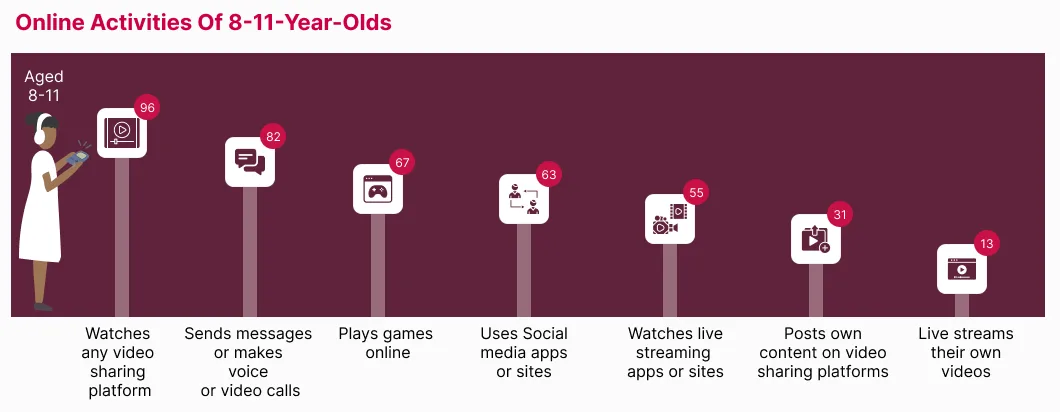
To address these issues, online age verification platforms provide a more effective and compliant solution in the market. The sections below explain how age verification works and why it has become necessary for organizations.
What Is Online Age Verification and How Does It Actually Work?
Online age verification is the process of accepting government-issued IDs, extracting a user’s birth date, and confirming age through automated checks.
Because this process involves access to sensitive data, many businesses rely on age verification API services providers such as Age App to handle verification securely.
Age verification APIs confirm whether users meet age requirements without exposing users identity.
Verification plays a key role in securing user data while fulfilling compliance and age-related requirements. times, people are confused between What is age verification, age gating, and age estimation, so lets understand them briefly with an explanation.
Difference between:
- Age verification
The process of confirming a user’s age through official documents, such as government issued IDs, producing a definitive result.
- Age gating
A method used to restrict access to websites or services for users below a specified age, usually through a checkbox or modal. It relies on self-reported information and offers limited protection.
- Age estimation
A technique that is used to estimate a person’s age when their exact birth date is not available and is typically used as a supplementary signal rather than a definitive check.
Why accuracy and privacy must coexist
Age verification systems must be accurate enough to prevent underage access without compromising user privacy. Effective solutions request only the data required for age computation and avoid collecting unnecessary personal information.
Why Online Age Verification Is Essential for Every Business Today
Online age verification is essential for regulated digital businesses, helping platforms comply, protect users, and prevent fraud without adding friction.
Legal and Regulatory Requirements
When a platform provides age-restricted products, or services, it is a regulatory requirement to have online age verification.
Failing to implement proper age verification can result in regulatory action, fines, and operational risk which can cause significant damage to your business and finances.
Protection of Minors
Online Age verification helps protect minors by restricting access to age-inappropriate products and content.
This reduces early exposure and the risk of addiction to unsuitable material available on the internet.
Beyond protection, age verification also promotes responsible access control early on, reinforcing safe digital habits from the start
“The internet was not designed with children in mind.” — Tim Berners-Lee
Fraud and Identity Misuse Prevention
Without age verification, it becomes easier for users to create fake accounts and share identities across multiple people to access the same platform.
This opens the door to fraud, and identity misuse, creating serious challenges for online platforms. By implementing a robust age verification API, you can minimize platform misuse and enforce restrictions effectively.
Brand Reputation and Reliability
Compliance sets your business apart, making it more credible than non-compliant competitors. By adhering to age verification regulations, you protect your brand from financial penalties and reputational damage, while reinforcing your commitment to ethical and responsible practices.
Online Age Verification Methods Explained for Businesses
Age verification for age-restricted services must be reliable to meet regulatory and safety standards while balancing compliance, security, and user experience. Here are the most common methods:
ID-Based Age Verification
One of the most widely used methods, supported by most age verification providers. In this approach, a user’s age is confirmed through government-issued ID cards.
Birth dates are matched against official government issued IDs and verified through shared government databases to prevent fraud.
While this method is highly accurate, it is not foolproof; errors in data extraction can lead to incorrect verification and even block legitimate users, which is a major limitation.
Biometric-Assisted Verification for Identity Confirmation
Many modern age verification platforms offer biometric matching to confirm whether an ID belongs to the user. To enhance security, Biometric liveness detection is added to ensure the user is physically present, and the biometric is not stolen or an outdated biometric sample.
This approach solves the biggest and growing issue of stolen and shared identity documents which affected more than 13.5 million consumers in 2025 just in the U.S. alone.

The biometrics used in this process are used solely for identity confirmation of the user, not for age estimation.
Token-Based Age Confirmation (Privacy-First Model)
If looking for a highly secure and privacy-first approach to age verification, you should look at token-based age confirmation.
This method converts a user’s age to a cryptographically signed token, and verification platforms only share a yes or no result.
By implementing this method, there’s no need to store ID’s or other personal data. Users can re-use their user-controlled age tokens across platforms, making this method both secure and privacy focused.
How Age App Verifies Users Securely and Accurately
Age App uses an automated system to verify user age precision and security, preventing misuse, identity fraud, and unauthorized access. Here’s how the process works:
What happens when a user initiates an age verification check
Age App supports verification wherever there is a requirement for age verification, whether through the app directly or by scanning a QR code to start the process.
How age verification systems confirm eligibility in real time
Users verify their age on by matching a government-issued ID with a live biometric scan.
This process confirms eligibility instantly without sharing personal identity details with the platform, ensuring privacy while granting or restricting access in real time.
How fraudulent and spoofing attempts are identified and blocked
Fraud prevention is achieved through real-time ID age verification against shared government databases. Additional measures like rate limiting are applied to prevent repeated requests from the same IP address.
Why automated age verification is faster and more reliable than manual checks
Manual checks have always been inefficient, error-prone, and risky. Mistakes can expose minors to inappropriate content and lead to regulatory violations.
Hence, automated age verification is a faster, more reliable, and scalable way to perform age verification for modern businesses.
Step-by-Step Guide: How Online Age Verification Works
This guide provides details on how online age verification operates, covering user initiation, eligibility checks, and decision- making, without compromising on accuracy, security and compliance.
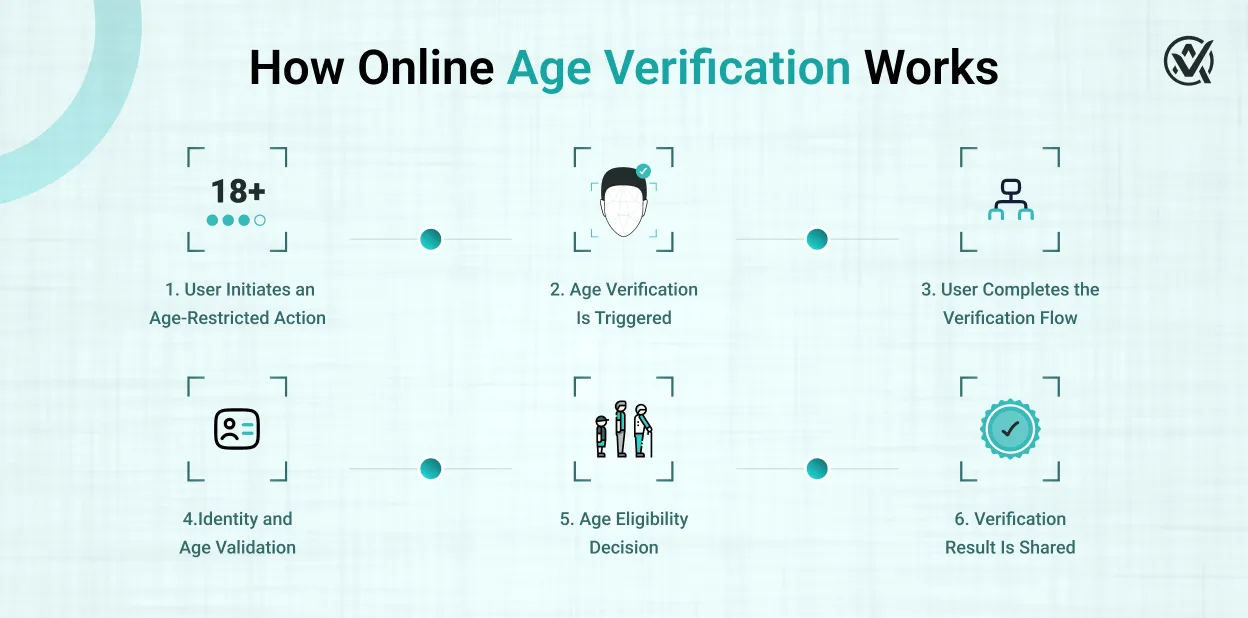
Step 1: User Initiates an Age-Restricted Action
The process is initiated by the user when attempting to access regulated content, sign up for a restricted service, or make a purchase for restricted items.
Step 2: Age Verification Is Triggered
Once the age-restricted action occurs, the platform triggers Age App by showing a QR code or a “Verify with Age App” button, which starts a secure, real-time verification session on the user’s device.
Step 3: User Completes the Verification Flow
Age App guides the user through a quick verification flow. The user takes a selfie, and it confirms liveness, making sure the person is physically present and real.
Step 4: Identity and Age Validation
After the user completes the verification flow, automated ID validation and fraud detection takes place.
Age App matches the live selfie to the user’s previously verified government ID (done once) to confirm the user’s age. This biometric ID match happens privately and securely.
Step 5: Age Eligibility Decision
It determines whether the user meets the required age threshold (e.g., 18+ or 21+). The platform receives a simple pass/fail result.
Step 6: Verification Result Is Shared
The platform receives a real-time pass/fail result. It never receives or stores full personal information, only the age-verified response.
By following this model, you ensure there is no need for platform-side storage and privacy of the user is also maintained.
How Online Stores Instantly Verify Customer Age
During onboarding or at the checkout point, online stores use real-time age verification to ensure that only eligible users can access restricted content, products or services, while allowing qualified customers to complete purchases without unnecessary friction.
Age verification during checkout or onboarding
Online stores can trigger age verification either during onboarding at the point of checkout, depending on when age eligibility is required.
Verifying age during onboarding is often more effective, as it allows platforms to apply age-based access rules once and avoid repeated checks during future purchases.
Preventing underage purchases of restricted products
With real-time age verification results, online stores can restrict and prevent underage users from accessing or purchasing restricted products on their platforms.
This platform helps them meet regulatory requirements and enforce age-based access consistently.
Reducing chargebacks, fraud, and compliance risk
When age verification is enforced before restricted purchases, platforms reduce the risk of chargebacks, misuse, and compliance violations related to underage transactions.
Ensuring minimal friction for legitimate buyers
When age verification is completed during onboarding, legitimate buyers can access eligible products without being asked to re-verify on every purchase.
The Role and Advantages of an Age Verification API
Age verification APIs provide real-time, scalable, and secure age eligibility checks for businesses that require such services.
These platforms usually have SDKs and APIs that can be integrated into websites, apps and checkout flows easier and automated age verification.
Because verification is automated and cloud-based, age verification APIs can scale efficiently as request volume increases.
Moreover, real-time responses allow platforms to make immediate access decisions without storing identity data.
Platforms like Age App provide APIs that allow systems to request age eligibility decisions without directly handling sensitive personal data.

Replace age gates with real-time verification.
Check age eligibility instantly through a secure API, without exposing personal identity.
Secure Age Verification with Age App
Top Challenges Businesses Face in Online Age Verification
Businesses implementing online age verification must accurately identify minors, manage user experience, and adapt to evolving regulatory requirements.
Identifying Minors Accurately
One of the main challenges is to accurately identify minors who may attempt to misrepresent their age or bypass age-verification controls.
Balancing Security and User Experience
Verification processes often add unnecessary friction to user experience, making it difficult for businesses to balance security and service design.
Reducing friction too aggressively can weaken verification controls, while overly strict flows can harm user experience. Effective systems balance both.
Navigating Evolving Regulations
As new privacy rules and age-restrictions are developed, it is challenging to navigate evolving global regulations.
Keeping up with changing age and privacy regulations across regions can be time-consuming and complex for businesses operating at scale.
Best Practices for Implementing Online Age Verification Effectively
By doing the best practices, you will be able to keep your age verification just as secure, compliant and user-friendly.
Using multiple verification layers : Using multiple verification signals improves resilience and accuracy when a single method fails or is unavailable.
Applying risk-based verification flows : Risk-based verification allows platforms to apply stricter checks only when higher risk is detected.
Keeping verification flexible and configurable : Verification systems should be configurable to adapt to different business models, products, and regulatory environments.
Reviewing and improving verification over time : Verification workflows should be monitored and refined over time to remain effective and proportionate.
What Users Experience During Online Age Verification
This section explains what users experience during online age verification; the steps they follow, what actions are required, and how quickly results are delivered.
What Users Are Asked to Do
During online age verification, users are guided through a short workflow that may include scanning a QR code, completing a biometric check, or confirming eligibility.
How the Process Feels
For most users, the process feels fast and straightforward, with clear instructions and real-time results.
Typical Verification Time
Most modern age verification systems provide real-time results, allowing platforms to apply access rules immediately.
Conclusion
Online age verification does more than protect minors from accessing sensitive platforms, it enables businesses to provide access to the right age group, and tailor user experience based on verification results.
It also plays a critical role in meeting global privacy and age-restriction regulations.
Modern solutions like Age app use secure, privacy-first methods such as automation, token-based verification, and API-driven processes to prevent fraud and safeguard users.
If your business operates in an industry with age restrictions, adopting a reliable age verification platform is essential. It ensures compliance, prevents misuse, and delivers a safe experience for your users.
Priscilla Miralles
Operations and Project Management Lead
Priscilla Miralles brings over 15 years of operational and project management experience to ChainIT, where she drives efficiency and supports seamless cross-team execution. Known for her strong administrative leadership and client service expertise, she excels at managing complex workflows and optimizing organizational processes.
Frequently Asked Questions
Have questions about how Age App works, what it stores, or where you can use it? You’re in the right place. This page covers everything from how we verify your age to how we protect your privacy without tracking you or exposing your identity.Online age verification works by accepting government issued ID documents from users, and validating the details with shared databases for identity and age verification.
Age checkers verify age online by interacting with shared databases for identity and age verification which have details about each user’s ID and other information.
Businesses can use modern platforms like Age app that provide seamless, and real-time age verification online for users across the globe.
Yes, most modern age verification platforms have APIs that can be integrated with your systems to perform fully automated age verification at scale.
Industries like gaming, gambling, alcohol, arms, online dating, ecommerce and many others rely on age verification systems to provide access to users above eligible age groups.
Age gating is a form of restricting users from accessing specific content or platform and insisting them to perform age verification to get access to the system.
No, age gating does not replace online age verification, it is rather a step before age verification which triggers users to perform age validation to access the platform.
Age App uses biometric liveness checks, ID-based verification, reusable digital identities, and secure online or in-person validation to confirm whether a user meets age requirements of 18 or 21.
Electronic age verification involves extracting age-related data from government ID cards for the user, and validating them with other shared databases that contain such data.
Online age verification is important for compliance as it helps in keeping the platform accessible to eligible users, reduces unapproved access and enhances safety of the platform.
Prove your age. Protect your privacy.

No more forms. No more stress. One app to verify them all.


